Belarus Versus Nicaragua Two Flags: A Deep Dive into High-Quality Vector Art and Design Utility
In the world of graphic design, stock photography, and digital illustration, few assets are as universally requested as national flags. Whether for educational materials, sports event graphics, political commentary, or international business presentations, the visual representation of a country is often the first point of contact for an audience. One specific, highly sought-after concept is the Belarus versus Nicaragua two flags comparison illustration. This article explores the significance of this specific pairing, the technical advantages of using isolated 3D waving flag designs, and how modern PSD templates empower creators to produce professional-grade content.
The Power of Visual Comparison in Modern Media
When we discuss "Belarus versus Nicaragua," we are not merely talking about a geopolitical rivalry or a sports match. In the context of design assets, this phrase represents a versatile template for comparison. The juxtaposition of two distinct national identities allows designers to create visuals that highlight differences in culture, history, geography, or statistics. For instance, a journalist might use such an image to compare economic indicators, while an educator might use it to teach students about the diverse cultural landscapes of Eastern Europe and Central America.
The visual impact of placing these two flags side by side creates an immediate cognitive link for the viewer. It invites curiosity. Why are they being compared? What is the narrative behind the image? By utilizing high-quality illustrations, designers can control the tone of this narrative, ensuring it remains respectful, informative, and engaging.
Understanding the Belarus and Nicaragua Flags
To appreciate the aesthetic value of these flags in an illustration, one must understand their symbolic weight. Both flags carry rich historical narratives that translate beautifully into digital art.
The Flag of Belarus
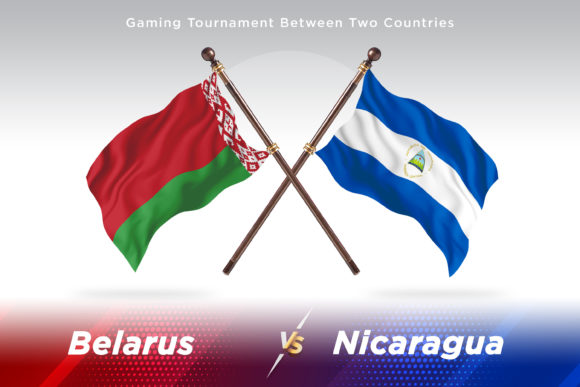
The flag of Belarus features a striking red horizontal stripe with a vertical white-red ornamental pattern on the hoist side. The red symbolizes the struggle for freedom and independence, while the white represents peace and purity. The ornamental pattern, known as "Ochak," is a traditional Belarusian motif that adds a layer of cultural depth. In a 3D waving illustration, the bold red and crisp white create a strong contrast that catches the eye immediately.
The Flag of Nicaragua
Nicaragua’s flag is a triband of blue, white, and blue. The outer blue bands represent the Atlantic and Pacific Oceans that border the country, while the central white band symbolizes peace and prosperity between the two oceans. At the center sits the national coat of arms, featuring a rainbow, five volcanoes, and a Phrygian cap. When rendered in a high-resolution PSD file, the intricate details of the coat of arms remain sharp, allowing for close-up views without pixelation.
Why Choose Isolated 3D Waving Position Illustrations?
In the era of digital media, static images are often insufficient. The trend has shifted toward dynamic, realistic representations that mimic real-world physics. This is where the isolated background illustration 3D waving position comes into play. Here is why this specific style is preferred by professionals:
- Realism and Depth: A flat vector flag can look sterile. A 3D rendering with proper lighting, shadows, and fabric folds gives the impression of movement and life. It suggests a breeze blowing across the fabric, adding a sense of dynamism to the composition.
- Versatility: An isolated flag on a transparent or white background can be easily placed over any other image, color, or texture. This makes it incredibly useful for composite designs, such as putting the flags behind a news headline or within a social media post.
- Professional Polish: High-quality 3D renders signal professionalism. They show that care was taken in the creation of the asset, which enhances the credibility of the final design project.
Technical Specifications: Maximizing Creative Control
For designers, the utility of a stock asset is often determined by its technical specifications. The bundle described—featuring Belarus versus Nicaragua Two Flags—offers a robust set of tools designed for maximum flexibility. Let’s break down what these features mean for your workflow.
Resolution and Dimensions
The primary file is provided at 4500 x 3000 pixels. This high resolution is crucial for several reasons:
- Print Quality: At this size, the flags can be printed large format, suitable for banners, posters, or exhibition displays, without losing clarity.
- Cropping Flexibility: High resolution allows you to crop the image to focus on specific details, such as the coat of arms on the Nicaraguan flag or the ornamental pattern on the Belarusian flag, without introducing blur.
- Future-Proofing: As screen resolutions continue to increase (4K, 8K), having source files with ample pixel data ensures your work remains relevant.
Layer Organization and Smart Objects
One of the most significant features of this asset is the use of smart objects and well-organized layers. In Adobe Photoshop, smart objects allow non-destructive editing. This means you can resize, rotate, or apply filters to the flag without degrading the original image quality. Furthermore, because each flag is isolated on its own layer, you can:
- Change the angle of the wave independently for each flag.
- Adjust the lighting or shadow effects separately.
- Remove one flag entirely if you decide to switch to a different country later.
- Apply color adjustments to just one flag to fit a specific brand palette.
Multiple Format Support
The inclusion of three file types—1 PSD, 1 JPEG, and 1 PNG—caters to different needs:
- PSD (Photoshop Document): The master file for detailed editing.
- JPEG: Ideal for web use where file size matters, providing a compressed but high-quality image.
- PNG: Perfect for designs requiring transparency, allowing the flags to blend seamlessly into various backgrounds.
Practical Applications in Business and Education
How does a designer actually use a "Belarus versus Nicaragua" flag bundle in the real world? The applications are surprisingly broad.
Educational Content Creation
Educators creating online courses or textbooks can use these illustrations to make learning more visually engaging. For example, a lesson on comparative economics could feature the flags alongside charts showing GDP per capita. The visual anchor helps students retain information better than text alone.
Sports and Events
In international competitions, whether Olympic or regional, flags are ubiquitous. If a tournament involves teams from Belarus and Nicaragua (hypothetically or in specific niche sports), this illustration provides a ready-made graphic for brackets, scoreboards, and promotional materials.
Digital Marketing
Marketing agencies often need to localize campaigns for different regions. A company expanding its services to both Eastern European and Latin American markets might use these flags to segment their advertising copy. The ability to edit the smart objects allows marketers to quickly swap out countries based on campaign performance data.
Addressing Common Misconceptions
There is a common assumption among beginners that downloading a stock image means they cannot modify it significantly. However, the description of this asset explicitly states that you can "edit your design via smart objects." This is a critical distinction. Unlike a locked raster image, a PSD with smart objects is a living document. You are not just using the image; you are collaborating with it.
Another misconception is that "versus" implies conflict. In design, "versus" simply means "comparison." It is a neutral term used to place two items side-by-side for analysis. It does not inherently suggest hostility. Designers should ensure that the surrounding context of their usage reflects this neutrality unless a competitive context (like sports) is intended.
Conclusion: The Value of Customizable Flag Assets
The "Belarus versus Nicaragua Two Flags" illustration is more than just a pair of images; it is a toolkit for communication. By combining high-resolution 3D realism with the flexibility of layered PSD files, this asset empowers designers to tell stories that span continents and cultures. Whether you are creating a simple blog post header or a complex international report, having access to well-organized, editable, and visually striking flag illustrations is invaluable.
If you find that you need flags for other countries not present in this specific bundle, remember that the principles discussed here apply universally. Look for assets that offer high resolution, smart object support, and clear layer organization. In doing so, you ensure that your work remains professional, adaptable, and impactful in an increasingly visual world.
Explore more global flag bundles to expand your design library and stay prepared for any international project.